
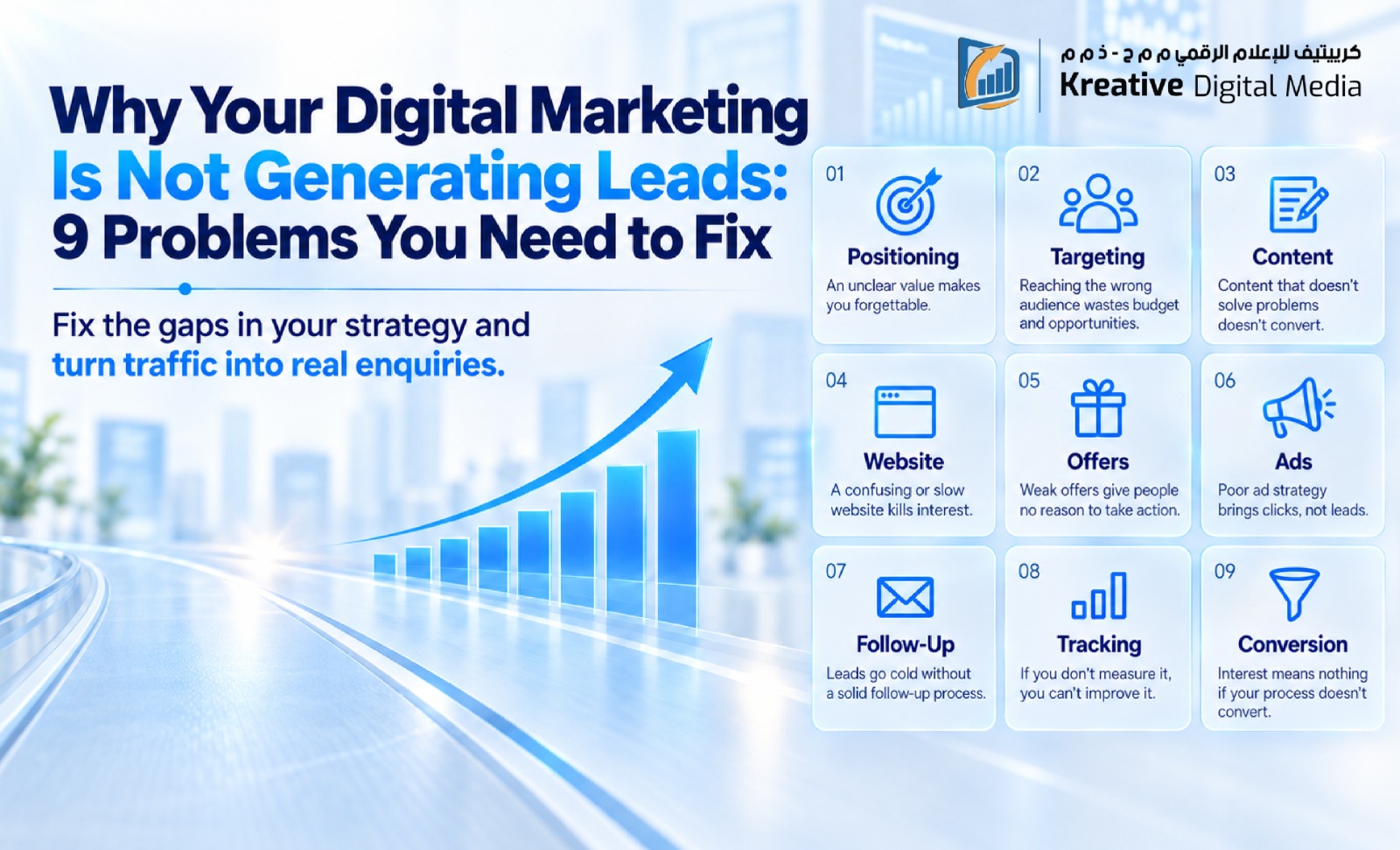
Why Your Digital Marketing Is Not Generating Leads: 9 Problems You Need to Fix
You are posting regularly. You are running ads. Your website looks professional. Your social media accounts are active. Nevertheless, the leads are not being received.
This is a frustration which business owners frequently encounter in the field of digital marketing; although they spend time and money on various channels, they are unable to achieve a steady stream of qualified enquiries. The real issue is generally not that digital marketing fails to work. The issue is that one or more of the components of the marketing system are not operating in coordination.
There are nine common reasons why your digital marketing might not be producing leads:
1. Your positioning is too general
The fact that your website states “We help businesses grow” means that you are not saying enough. Who do you help? What problem do you solve? Why should someone pick you? You should frame your position so that the answers become clear.
For instance, the statement ‘We provide digital marketing services’ is rather general. The statement ‘We help B2B companies generate qualified leads through SEO, paid advertising and LinkedIn marketing’ is considerably clearer. A strong market position enables the correct customers to realise that your business is relevant to them. If you want to increase your advertising expenditure, first of all ensure that your value proposition is clear.
2. You Are Aimed At Everyone
The attempt to reach all people generally results in your marketing failing to make any impact. A founder of a startup, a local retailer and a well-established manufacturer all have quite different requirements; their budgets, the way in which they buy and the processes they go through when making decisions are also different.
Define your ideal customer based on factors such as:
- Industry
- Company size
- Location
- Buying behaviour
- Pain points
- Budget
Business goals
The clearer your understanding of your audience, the easier it will be to come up with relevant campaigns and content.
3. Your content attracts views but fails to generate demand
The fact is that a high reach does not necessarily lead to high revenue. A post can be viewed thousands of times and yet produce no inquiries. Why? Attention and intent to buy are two different things.
Your content should educate people and also enable them to understand the problem, recognise its impact, and see the importance of your solution. Rather than just posting ‘5 digital marketing tips’, explain why businesses which have a high volume of website traffic may still have difficulty in attracting customers. The kind of content you produce will draw in those people who are going through the problem that you offer a solution for.
4. Your website is losing potential customers
Even if you are able to bring traffic to your website, your marketing investment will have been wasted if the visitors do not know what to do next.
Your website should quickly communicate:
- What do you offer?
- Who is it for?
- What problem is it addressing?
- What should make customers place their trust in you?
What is their next move?
You should also have clear calls to action. “Contact Us” is okay, but using a more specific call to action like “Book a Free Consultation” or “Request a Marketing Audit” makes it easier to understand what the next step should be.
5. Running ads before fixing your offer
No matter how hard advertising is carried out, it cannot save a poor offer. Unless your campaign just states ‘Get our marketing services’, there won’t be much to encourage people to respond.
A stronger offer could be: “Obtain a free 30-minute digital marketing audit to find out the three main gaps that are impacting your lead generation.” The second proposal provides the prospective customer with a clear reason to take action. Before you increase your ad budget, consider whether your offer is truly compelling.
6. You’re Using the Wrong Marketing Channels
It is not necessary for every business to have a presence on every platform. A B2B consulting firm can gain substantial advantages from using LinkedIn and Google Search. A local restaurant could place greater reliance on Google, Instagram and local search. It is possible that an ecommerce brand will find Meta Ads, Google Shopping and influencer marketing to be more effective.
Select channels according to how customers behave rather than following trends. Ask yourself: “Where does my customer look when they have the problem that I solve?” You should start with that in your marketing.
7. Your Follow-Up Procedure Is Inadequate
Getting a lead is only the very first step. You might have lost the potential customer’s attention even if they complete your form today and don’t hear back from you for two days. The follow-up procedure should involve making timely calls, contacting the person by means of WhatsApp or email, providing useful resources, including case studies, and giving answers to common objections.
It isn’t the case that all prospects will make an immediate purchase. People need to have several conversations before they are ready. Marketing brings the opportunity; follow-up helps convert it.
8. Marketing and Sales Do Not Work Together
One of the most common business problems is when Marketing says, “We got 300 leads,” while Sales remarks that “most of them were useless.” This is generally a sign of an alignment issue.
Marketing should receive feedback from sales regarding the quality of leads, the objections raised by customers, common questions and the reasons why prospects decide not to make a purchase. Sales should also know which campaigns produced the leads and what commitments were made. Lead quality tends to improve when the marketing and sales teams base their work on the same customer insights.
9. You Are Assessing Vanity Metrics
Following, liking, getting impressions and having views can all serve as useful indicators, but that is not the end of the journey. Businesses should track meaningful metrics rather than superficial ones.
- Cost per lead
- Cost per qualified lead
- Conversion rate
- Customer acquisition cost
- Lead-to-customer ratio
- Average order value
Revenue generated
A campaign which achieves 100,000 impressions yet brings about no customers is not a success. A campaign achieving 10,000 impressions and resulting in 20 qualified customers might be considerably more valuable.
What should you repair first?
You should not immediately boost your marketing budget. Start by auditing the entire customer journey: start with your positioning, then look at your target audience, your offer, your content, your website, your acquisition channels, and your follow-up process. Lastly, link your marketing data to real sales results.
Digital marketing is an interconnected system rather than just a strategy for obtaining more traffic or followers. Attention creates awareness, content builds trust, a solid offer leads to action, follow-up creates relationships, and the sales team turns those relationships into revenue. If a component of that system fails, then increasing spending on marketing won’t solve the problem. At times, a greater number of leads is not necessary—you simply have to cease losing the leads that you are currently generating.

jagmohanDev
Discover more insights, updates and useful information from the KDM team.